





|
|||||||||||||||||||||||||
|
|||||||||||||||||||||||||
|
|
Features > Iams Exec Criticizes Laboratory Tests!
Iams Exec Criticizes Laboratory Tests!
Iams should have no trouble patenting doublespeak. The company is an expert
at talking out of both sides of its mouth—whatever suits the moment
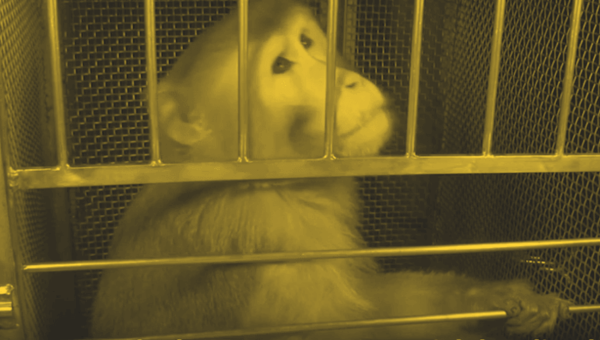
is what is endorsed.In its 2004 annual shareholder proxy statement, Procter & Gamble (P&G), Iams’ parent company, responded to PETA’s call for an end to pet-food testing on animals caged in laboratories by stating, “In some cases, Iams must use controlled kennel or cattery environment nutritional studies to confirm a significant new health benefit for a formulation and its safety for dogs or cats. … The suggestions in [PETA’s shareholder] resolution, which include ending all controlled kennel or cattery environment feeding studies, would impede efforts to continue enhancing the well-being of dogs and cats.” P&G was banking on the fact that no one would notice the inconsistencies in its policies as stated by its very own Diane Hirakawa (senior vice president of Iams’ research & development division). In a 2001 Petfood Industry Electronic Newsletter, Hirakawa stated, “The lesson learned here is that kennel studies are not an appropriate way to test feeding guidelines because most kennels represent a high-stress … environment. Naturally, in such an environment, dogs may need to consume more food than they would in a home setting.” Hirakawa was desperately trying to respond to an ongoing lawsuit brought against Iams by rival pet-food manufacturer Nutro, which conducted kennel (laboratory) experiments on Iams food to demonstrate that Iams had unlawful and misleading feeding guidelines which could potentially endanger the health of many companion animals. Judging from the criticism leveled by the Food and Drug Administration (FDA) on Iams regarding this lawsuit, it seems that the FDA is poised to take Iams to task for its deceitful ways: “We are concerned that the recommended amounts listed on Iams products for adult maintenance … are insufficient for the intended use of the product as represented on the label.” For more information about this lawsuit, please click here. Hirakawa—a senior executive at Iams—has finally told the truth and openly admitted that kennel (laboratory) experiments “represent a high-stress … environment” and that they “are not appropriate” or even justified, for that matter, for conducting scientifically reliable feeding trials! It is ludicrous for her to make these statements in Iams’ defense in one case, but then completely ignore them while working with P&G to compose the company’s 2004 shareholder proxy statement, in which P&G maintains that Iams “must” conduct kennel (laboratory) experiments! It is a well-known fact that stress on animals affects the outcome of any test. Iams must move to cruelty-free in-home testing methods, non-animal chemical analyses, and cooperative studies with veterinary clinics whose human clients have volunteered their companion animals because they are already suffering from target diseases. Subjecting innocent animals to cruel laboratory pet-food experiments that are not required by law is simply inhumane, irresponsible, and scientifically unreliable. Doublespeak isn’t harmless when it comes to Iams. It causes suffering—loneliness, anxiety, stress, and even death. Please e-mail Hirakawa, or send her a letter at the address listed below, asking her to stand by her words and use her senior position to effect change at Iams: Diane Hirakawa, Ph.D. |
|
|||||||||||||||||||||||
|
|||||||||||||||||||||||||